
Understanding Attachment Styles in Relationships: What They Mean and Why They Matter
I’m sure most of you are familiar with the idea of attachment styles, and maybe even understand some of the dynamics that occur in relationships as a result of these differences in people’s approach to connection. In this post, I want to go over some of the most fundamental aspects of attachment theory for those who aren’t familiar with this topic or who just want a little refresher, and I also want to discuss the ways in which these differences in the ways we connect emotionally can create important stressors in relationships. Understanding the basics of attachment styles can help couples avoid some of the most common pitfalls of relationships which can sometimes be easily rectified with just a little bit of knowledge about you and your partner’s styles of connection.
The most important thing to understand about attachment patterns is that they are not random. They often reflect deeper emotional wiring called attachment styles. These styles are formed early in life, shaped both by our genetics and our upbringing, and show up again and again not just in romantic relationships, but indeed in any close emotional relationship. Understanding your own and your partner’s attachment style can dramatically improve how you relate, communicate, and build trust, and can also help you avoid some of the most common pitfalls that couples fall into. So let’s get started.
What Are Attachment Styles?
Attachment styles are patterns of relating with one another that we develop in early childhood, and typically correspond with the way our caregivers responded to our emotional needs (though genetic predispositions certainly play a part here too). These styles influence how we connect with others, how we handle conflict, and how safe or secure we feel in relationships.
Generally speaking, there are four main attachment styles outlined below. It’s important to remember that very few people occupy one attachment style permanently. Someone might typically identify as a securely attached individual, but even that person could feel anxious or avoidant in certain circumstances, so don’t rush to pigeonhole yourself into one particular style.
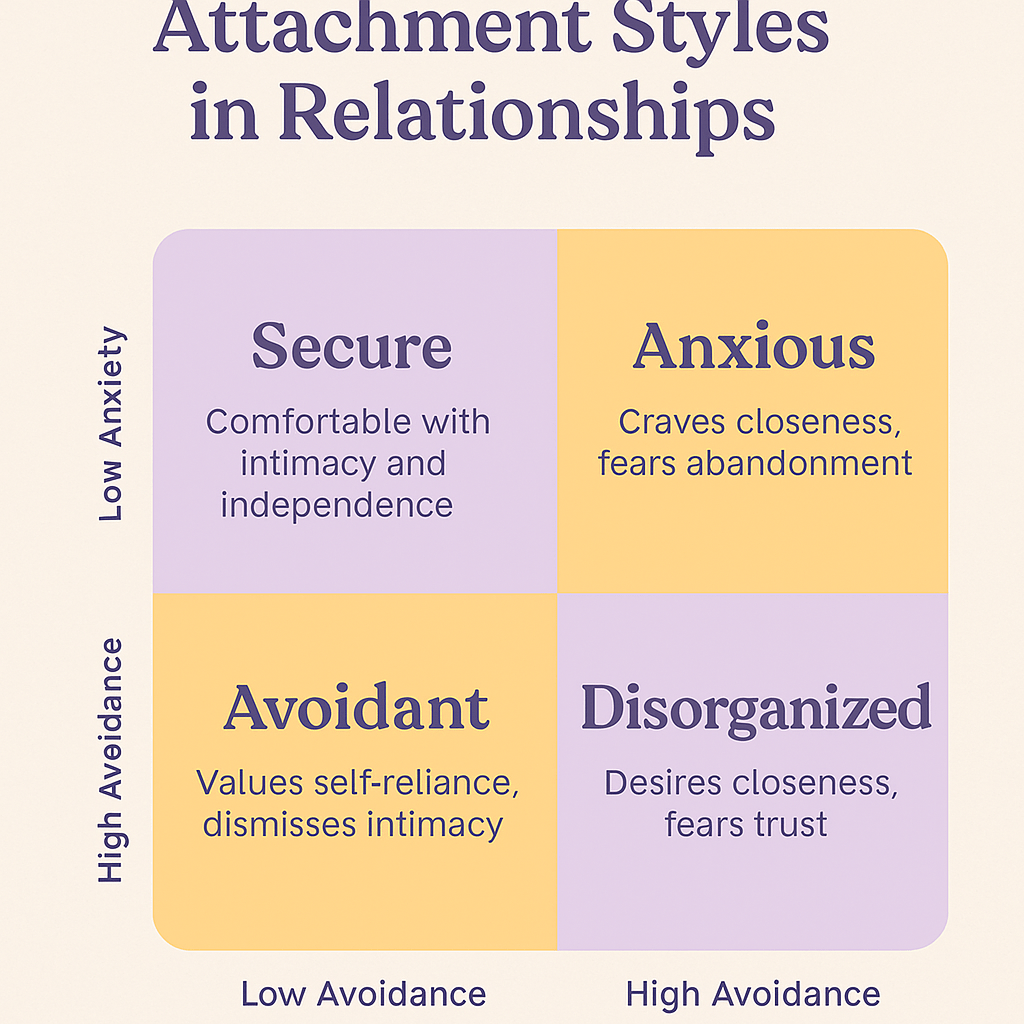
1. Secure Attachment
Core traits:
- Comfortable with closeness and independence
- Trusts easily and communicates directly
- Seeks connection without fear of abandonment
In relationships:
Securely attached individuals generally feel comfortable with emotional intimacy, are confident in expressing their needs, and are responsive to their partner’s emotions. They tend to believe that they are lovable and that others are dependable. This doesn’t mean they’re perfect, but they have internalized a basic sense of safety in relationships that helps them feel, well, secure!
Example Situation: A Conflict Over Time Together
Let’s say two partners, Jamie and Alex, have been busy with work. Jamie tells Alex:
“I’ve been feeling a bit distant lately, I miss our time together.”
A securely attached Alex might respond with something like:
“Thanks for telling me. I’ve been feeling something a little off but couldn’t exactly put my finger on it. I’m glad you brought it up. Do you want to plan something just for us this weekend?”
This is a super simple interaction , but it shows:
- Openness to feedback (Alex doesn’t get defensive or withdraw),
- Willingness to reconnect emotionally,
- A collaborative mindset toward problem-solving.
Key Traits in Relationship Dynamics:
- Emotional attunement: They recognize and respond to their partner’s emotional needs.
- Repair after conflict: They’re usually comfortable apologizing, clarifying misunderstandings, or checking in.
- Interdependence: They balance autonomy with closeness. They can be together or apart without spiralling into anxiety or detachment.
2. Anxious Attachment
Core traits:
- Fears abandonment or rejection
- Craves reassurance and closeness
- May become preoccupied with the relationship
In relationships:
People with an anxious attachment style tend to crave closeness and reassurance, but often doubt their worth in the relationship. They can be emotionally expressive but also hyper-sensitive to perceived rejection. They may seek connection but in a way that sometimes overwhelms or pressures their partner and betrays their general feeling of insecurity in close emotional situations.
Example Situation: A Conflict Over Time Together
Again, Jamie says:
“I’ve been feeling a bit distant lately, I miss our time together.”
An anxiously attached Alex might respond with:
“Are you saying you’re not happy with me? I’ve been trying so hard, and now you’re pulling away too? What does this mean for us?”
This shows:
- Fear of abandonment: The comment is globalized and interpreted as a threat to the relationship.
- Over-personalization: Jamie’s needs are taken as criticism or rejection and instead of staying attuned, Alex becomes defensive.
- Urgency to fix or secure the bond, but from a place of panic rather than calm connection. The attempt to fix the bond comes from a fear of loss, rather than concern for the partner’s well-being.
Key Traits in Relationship Dynamics:
- Preoccupation with the relationship: Frequent worries about being loved or valued enough.
- Need for reassurance: Regularly seeks validation and closeness, sometimes excessively.
- Conflict escalation: Emotions run high during disagreements, often leading to emotional flooding, clinging, or protest behaviours (e.g., guilt-tripping, testing the partner’s love).
3. Avoidant Attachment
Core traits:
- Highly values independence as a defensive manoeuvre
- Uncomfortable with vulnerability or emotional intensity
- Tends to withdraw under stress
In relationships:
People with an avoidant attachment style typically value independence and emotional self-sufficiency, but not from a place of self-sufficiency or comfort. They often downplay the importance of close connection and may feel overwhelmed or smothered when others express emotional needs. This isn’t because they don’t care or don’t need intimacy, but because intimacy can feel threatening or unfamiliar.
Example Situation: A Conflict Over Time Together
Jamie says:
“I’ve been feeling a bit distant lately, I miss our time together.”
An avoidantly attached Alex might respond with:
“I don’t get why this has to be a big deal. We’ve both been busy and you’re constantly asking for more. I feel like you’re smothering me.”
This response reflects:
- Minimization: Emotional needs are de-emphasized or dismissed.
- Discomfort with vulnerability: Alex may feel exposed, pressured, or intruded upon.
- Withdrawal or intellectualization: Instead of engaging emotionally, Alex might shift to logic or try to end the conversation.
Key Traits in Relationship Dynamics:
- Shutting down in conflict: Often uses defensiveness, stonewalling, or avoidance to cope with a deeper anxiety.
- Pulling away when things get too close: May feel smothered by emotional intensity.
- High value on autonomy: Needs for space can override needs for connection.
- Low tolerance for emotional demands: May feel criticized even by reasonable requests.
4. Disorganized (Fearful-Avoidant) Attachment
Core traits:
- Craves intimacy but fears it at the same time
- History of trauma or inconsistent care giving
- Struggles with trust and self-worth
In relationships:
Disorganized attachment is often rooted in early experiences of trauma, neglect, or inconsistency. Individuals with this style may have conflicting desires: they deeply long for connection, but also fear it. As a result, they often behave unpredictably, pushing partners away just as they draw them close, often mimicking the unpredictable way that they received love in their own childhood.
Example Situation: A Conflict Over Time Together
Jamie says:
“I’ve been feeling a bit distant lately, I miss our time together.”
A disorganized Alex might respond in a way that fluctuates or feels confusing:
“I don’t know… maybe we just don’t work anymore. I’m really afraid that I’m going to lose you every time we fight. I don’t know what you want from me!”
This response reflects:
- Emotional chaos: Rapid shifts between closeness and distancing.
- Fear of abandonment and intimacy: Both are present at once, leading to inner conflict and outer confusion.
- Confused communication: May seem reactive, unpredictable, or contradictory.
Key Traits in Relationship Dynamics:
- Shame and self-doubt: They may fear being “too much” or “not enough,” or even both at different times.
- Push-pull dynamic: One moment they may crave intimacy, the next they pull away.
- High reactivity to conflict: Often feel overwhelmed, panicked, or out of control.
- Difficulty trusting: Even loving gestures may be met with suspicion.
Want Support Putting These Into Practice?
If you and your partner are trying to work on attachment issues but feel stuck, you’re not alone. These tools are powerful, but they work best with practice, patience, and support.
- Book a couples session today, OR
- Bookmark this page to revisit when you need a refresher
Can Attachment Styles Change?
Yes, attachment styles, though pervasive and deeply rooter, aren’t fixed. While our genetic predispositions and early experiences shape us, we can absolutely grow toward earned secure attachment. That means learning how to regulate emotions, communicate needs safely, and develop trust, even if you didn’t grow up with those tools. All of this requires intention, attentiveness, and a willingness to trust and open up to your partner: all difficult things for insecurely attached individuals. A good couples therapist can help mediate this complicated negotiation by helping stabilize the conversation, manage emotions, and stop or reroute the conversation when couples are using dysfunctional or ineffective communication strategies.
While difficult, individual change is possible through consistent self-work, healthy relationships, and emotional insight.
1. Increase Self-Awareness
Understanding your attachment style is the first step.
- Journal your emotional triggers in relationships.
- Reflect on past relationships: When did you feel abandoned, overwhelmed, clingy, or shut down?
- Identify your default response to conflict: fight, flight, freeze, or fawn?
2. Name and Challenge Your Core Beliefs
Each attachment style is shaped by internal working models. I’ve listed some of the most common core beliefs below:
- “I’m not lovable.”
- “People will always leave.”
- “I can only rely on myself.”
Work on reframing these beliefs with evidence-based thinking:
- “My needs are valid.”
- “Not everyone will hurt me.”
- “I can ask for what I need.”
3. Practice Secure Behaviours
Acting as if you are securely attached can, over time, rewire emotional patterns.
- Communicate needs clearly and calmly.
- Pause and self-soothe before reacting impulsively.
- Set and respect boundaries.
- Practice emotional regulation: breathing, grounding, self-talk.
4. Cultivate Safe, Reliable Relationships
Healing often happens through connection.
- Surround yourself with emotionally available, supportive people (yes, this is harder than ever in today’s world, but still worth focusing on).
- Allow yourself to be vulnerable in small, manageable doses, and see how others around you respond to that.
- Observe and emulate secure behaviour in trusted friends or mentors.
How Therapy Helps Change Attachment
1. The Therapeutic Relationship Itself
A strong client–therapist bond offers a corrective emotional experience, reliable, attuned, and non-judgmental. The relationship with the therapist is an important re-enactment of other core relationships. In a way, the client and therapist share a specific kind of relationship based on trust, openness, non-judgment, and general positive concern for the client’s well-being. All of these things are similar to the relationships we have with our first caregivers, and modelling a healthy version of that relationship in therapy can be extraordinarily healing as some individuals experience another person’s care and genuine concern for the first time.
2. Emotion-Focused Therapy (EFT)
EFT is my preferred method of working with individuals and couples in relationship contexts. It helps clients access and regulate emotions in a safe setting, and teaches them how to probe and interpret their partner’s emotional reactions. Particularly useful for couples, it reshapes how people reach for and respond to each other in moments of vulnerability, and is a fantastic way of talking about deeper emotional needs in a relationship.
3. Attachment-Based Psychotherapy
Similar to EFT but more trauma focused, Attachment-Based Therapy directly focuses on early relational patterns and their impact. It helps:
- Process trauma and unmet childhood needs.
- Build internal security.
- Replace reactive patterns with mindful responses.
Why This Matters for Couples
1. They Drive How We React When We’re Hurt
Attachment styles are especially activated during emotional stress, like when we feel:
- Misunderstood
- Criticized
- Abandoned
- Smothered
For example:
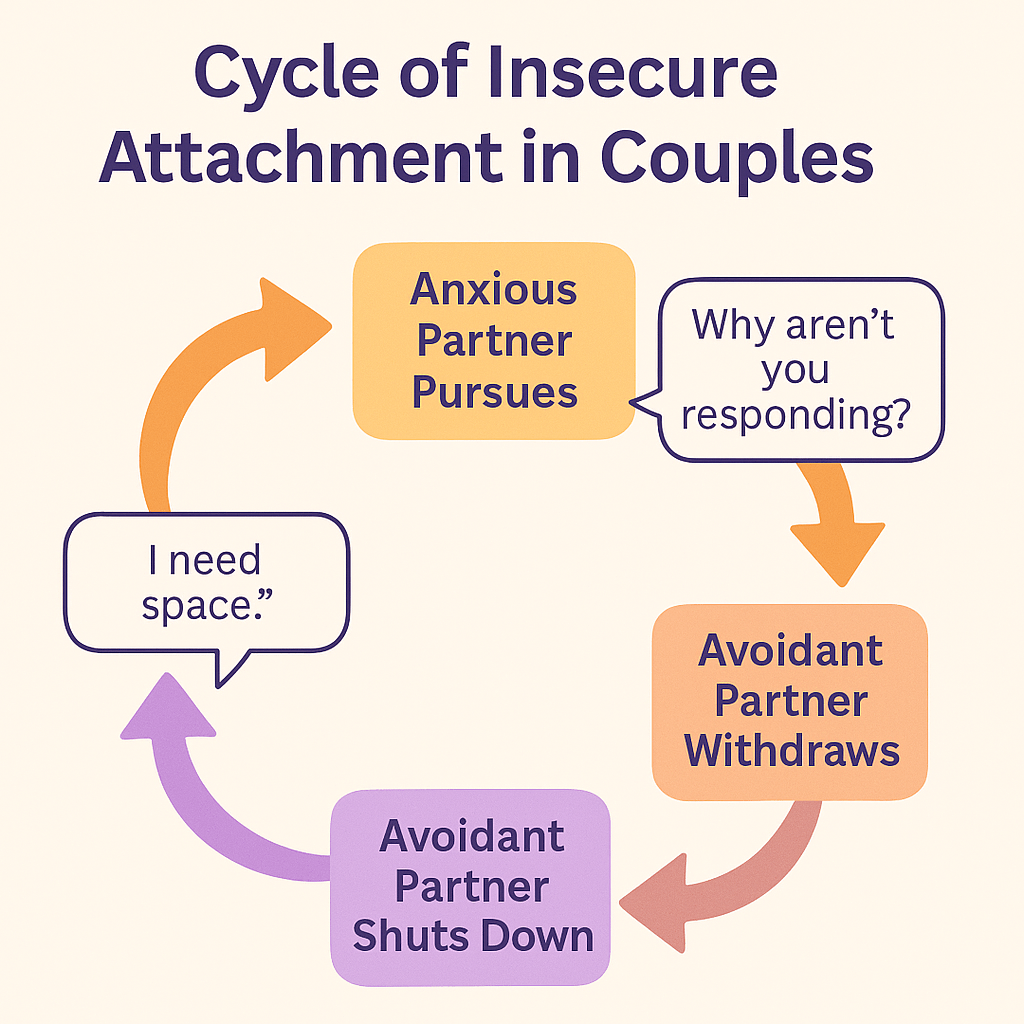
An anxiously attached partner might become clingy or accusatory when they feel distant.
An avoidant partner might shut down or pull away, triggering more pursuit.
2. They Shape How We Ask for (or Avoid) Emotional Needs
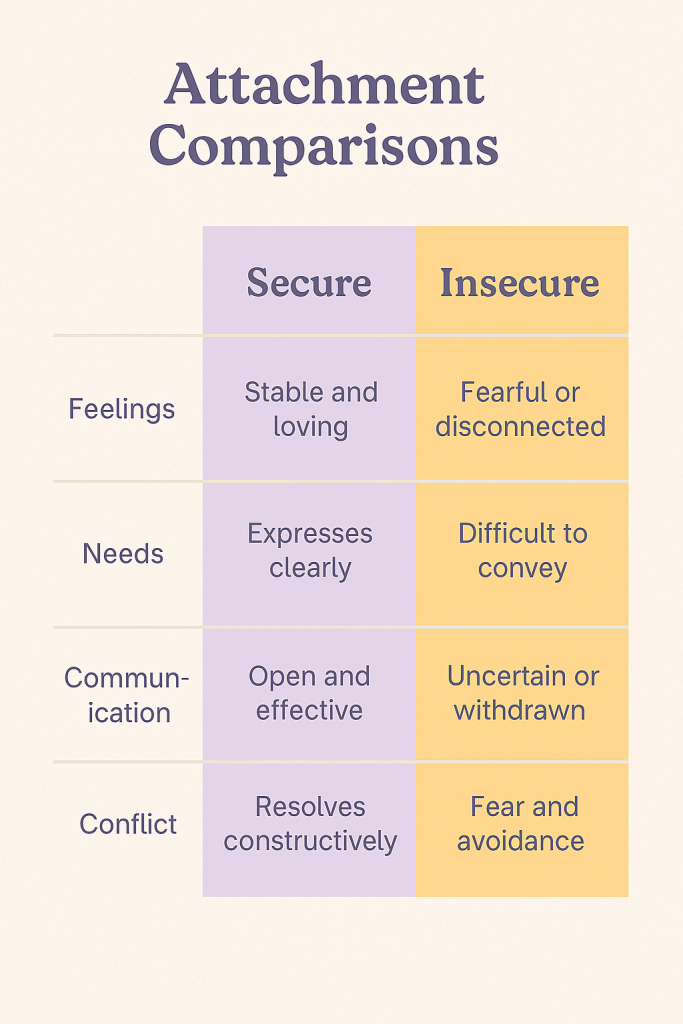
- Avoidant partners may struggle to name their emotional needs or feel guilty for having them.
- Anxious partners may overexpress needs or fear being “too much.”
- Secure partners can express needs directly and receive them calmly.
This mismatch often creates pursuer-distancer dynamics, a major source of conflict in couples therapy.
3. They Explain Repeat Fights That Never Seem to Resolve
Couples often fight about surface issues (money, chores, texting back), but beneath these are attachment fears like:
- “Do I matter to you?”
- “Will you leave me?”
- “Can I count on you?”
- “Am I good enough?”
Understanding each other’s attachment wounds reframes arguments from “You’re being unreasonable” to “Oh, this is about feeling unloved or unsafe.”
What Secure Attachment Offers to a Relationship
When one or both partners move toward secure attachment, they begin to:
- Co-regulate emotions (soothing each other, not escalating)
- Repair conflicts faster and more effectively
- Communicate feelings without blame or withdrawal
- Create a stable base where both feel accepted, valued, and free to grow
This creates what psychologist Sue Johnson (founder of EFT) calls a “secure bond“: a resilient, emotionally safe relationship.
In Couples Therapy: Why We Focus on Attachment
Attachment work in couples therapy helps partners:
- Recognize each other’s emotional survival strategies
- Shift from blame to empathy and emotional attunement
- Practice new ways of connecting during vulnerable moments
- Build a relationship that feels safe, warm, and resilient
If you found this content useful, try some of my other informative pages:

Still have questions or unsure if therapy is right for your relationship? Book a free 15-minute consult with a couples therapist. I’d be happy to talk it through with you. No pressure, just clarity.
 Ari's Therapy